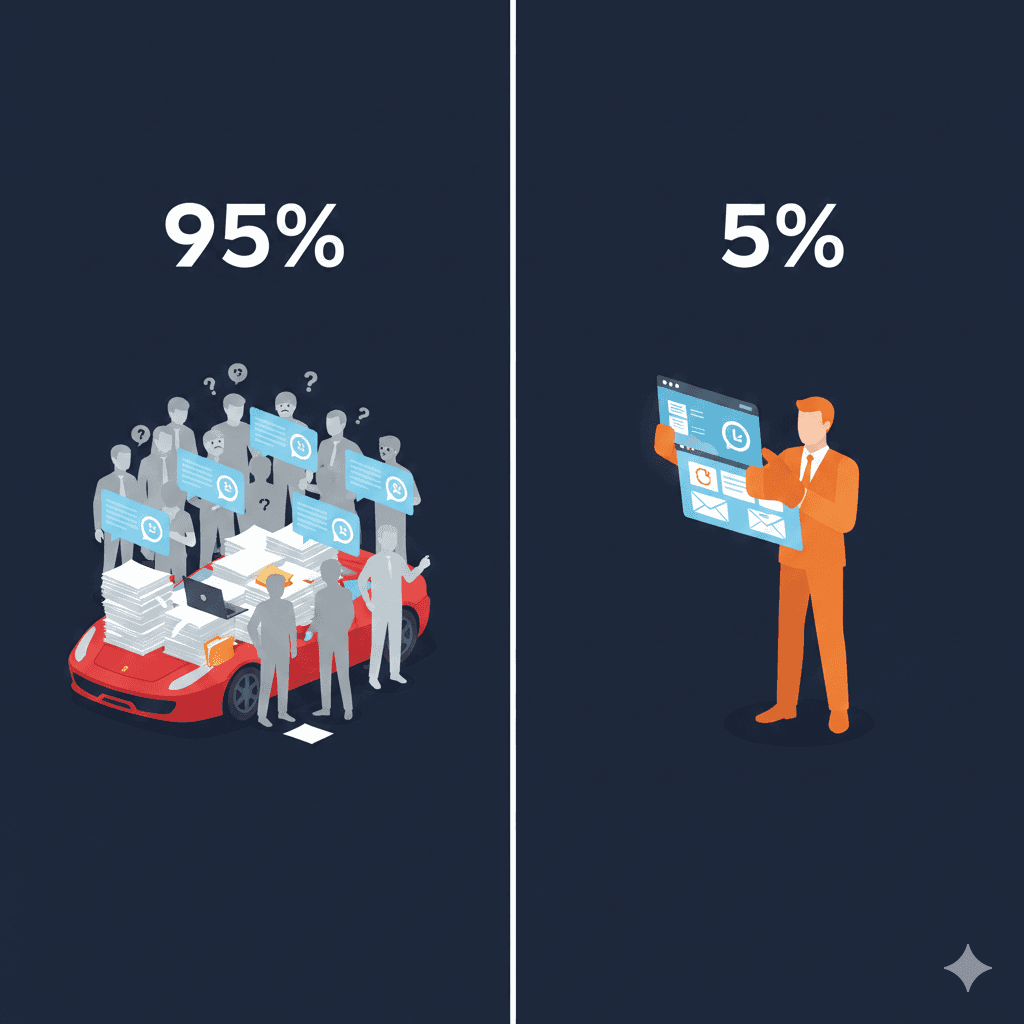
A new EY survey of 15,000 employees across 29 countries just confirmed what every construction company feels but can't articulate: 88% of workers use AI tools daily, but only 5% are actually getting real value from them.
That 5%? They're gaining an extra day and a half of productivity every single week. The other 95% are stuck using AI for basic searches and document summaries. As the article put it: "treating a Ferrari like a golf cart."
OpenAI's own data backs it up. Their State of Enterprise AI report shows that frontier workers — the top 5th percentile — send six times more prompts than the median employee. For coding tasks, it's 17x. Same tools, same access, wildly different results.
The industry's answer? More training. AI councils. Show-and-tells. Teach your people to prompt better.
Respectfully, that's the wrong answer.
Here's why: the article itself reveals the real problem. BCG found that only one-third of employees say they've been properly trained on AI. And the gap is widest among front-line employees — 51% adoption versus 75%+ for leaders and managers.
Front-line employees. The PMs. The estimators. The service techs. The people who actually touch the customer every single day. They're the ones falling behind. And the solution is supposed to be... workshops?
We took a different approach at Atlas Intelligence.
Instead of training every person to be an AI power user, we built each person their own AI-powered program. The expense person doesn't need to learn prompt engineering — they upload a receipt and get a categorized report in 2 minutes. The project manager doesn't need to iterate on ChatGPT — they upload a PDF and get a project timeline. The salesperson doesn't need to master a generic AI tool — their email drafter already knows their deals, their contacts, and their history.
One person, one program. All connected.
The EY data says 5% of workers figure out how to use AI effectively on their own. We think that's a design failure, not a people failure. If 95% of your workers can't extract value from a tool, the tool is broken — not the workers.
The article quotes Ofer Klein: "The highest performers spend more time on strategic work because AI handles the grunt work. They use AI to augment their expertise, not replace thinking." That's exactly right. But why should only the top 5% get that benefit?
When every person has a program built specifically for their job — not a generic AI tool they have to figure out — every person becomes a power user by default. The receptionist. The estimator. The PM. The sales rep. Each one gets AI that fits their workflow like a glove, not a one-size-fits-all platform they have to wrestle into submission.
The math from the article is stark: in a 100-person company where 60 employees barely touch AI, you're losing 40-60 hours of productivity every single day. That's 10,000+ hours a year. Five full-time employees' worth of work, wasted.
You don't close that gap with training decks. You close it by making every person's program so intuitive, so specific to their job, that using it IS the job. Not an extra step. Not a new skill to learn. Just... the way they work now.
The 5% figured it out on their own. Atlas makes the other 95% just as powerful — not by teaching them to be different, but by building programs that meet them exactly where they are.
We don't train 5%'ers. We create them.
"AI Power Users Are Rapidly Outpacing Their Peers. Here's What They're Doing Differently." — Kolawole Adebayo, Inc. (Feb 6, 2026) Read the full article →
Ready to see what custom AI can do for your company?
Your construction expertise. Our AI. Let's talk.
Request a demo